growing inventory of collective art practices
sometimes bodies and minds need time to macerate, disaggregate, digest, and reassemble. let the process take its time; let time be the process. yes, this is a blog post about a tender, creative moment last summer – when the warmth of the mountainside of monte gambargono still warmed our faces. recalling the joy of the abundant sunbeams, smelling again the aromatic late-summer air, and feeling the dopamine rush after the tickling cold swim in the lake, we finally upload this post.
we gathered at casa sasso in the aim of getting to know each other, sharing and unfolding our evolving cultural and artistic practices, as well as to interogate and draw a swiss landscape continuously shaped by the rise and the disappearance of collectives. our journey at sasso residency was a wager, an attempt to foster dialogues between different tongues. how to find a language to think with linguistic, medium, theoretical, practical and sensitive differences?
often, answers are not those expected. often, when spontaneity is nurtured, these answers contribute to feed another soil.
– vera, cassiane
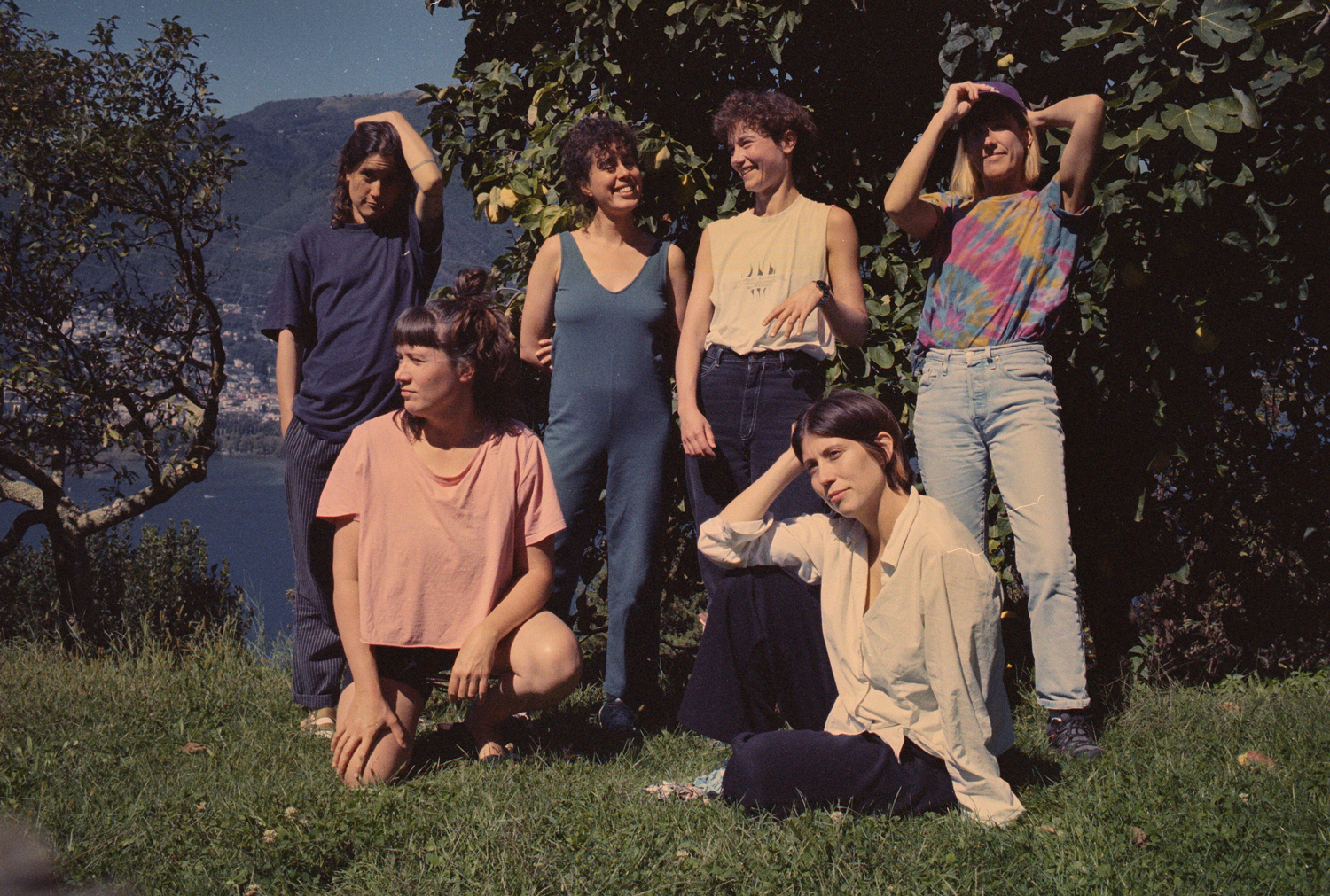
image © claude bühler, 2025
below you can read or listen to extracts from the text(s) ‹wandering through the house with cassiane c. pfund and vera mühlebach›. during the open doors, the public was invited to visit the house and immerse itself using QR codes.
these are experimentations, fragments of voices and words which came to life within and about the walls that have witnessed our presences. we wished them to let old and new foundations occur, gardens and fruits, places and memories interfere.
JARDIN
zero/zéro/null/zero
le jardin de la casa sasso raconte des mouvements : celui des abeilles, des lézards qui se faufilent entre les têtes de chat sommeillant dans la cour, non loin des mouches agglutinées aux figues trop mûres tombées au sol.
je ne vais pas m’attacher à décrire ce que le jardin recèle de comestible. déjà, j’ai beaucoup à apprendre. ensuite, j’aimerais simplement célébrer ce lien intime et mystérieux avec ce qui est : une fois qu’on s’y attarde, après avoir cueilli, après avoir porté à la bouche ou frotté, les textures et les odeurs, les miettes qui, sur la planche en bois ou le col du t-shirt, se retrouvent désormais transportées par les fourmis et autres corps souvent considérés minuscules.
chaque jour, nous nous retrouvons à la cuisine. c’est un atelier où nous nous amusons à expérimenter des goûts qui nous sont nouveaux, à développer un langage en-dehors de nos têtes – elles ont besoin d’une pause –, après le croisement des mots que nos langues parlent et de ce que nous écoutons en silence. notre amitié caramélise au fond d’une poêle, les aliments se font sans nous. ils se préparent, infusent, marinent, sèchent et confisent à leur rythme. ici encore, le jardin poursuit son oeuvre, il demande de faire confiance. alors pour l’instant, juste pour l’instant, il s’agit d’imaginer, de sentir nos pieds ancrés dans le sol, l’herbe humide après les pluies nocturnes, nos mains tenir les ciseaux, le cueille-fruit approcher des cimes, nos ongles pincer juste ce qu’il faut dans un geste à la fois ferme et parcimonieux.
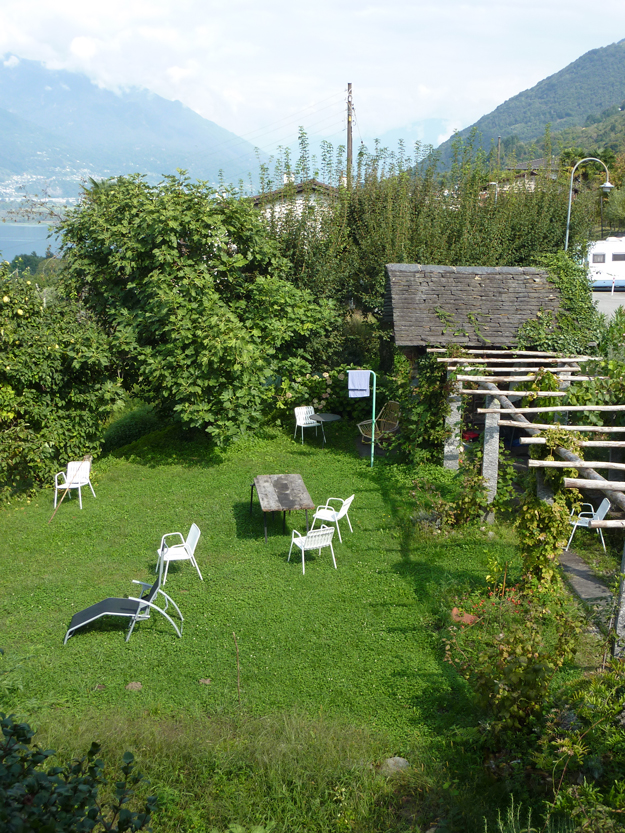
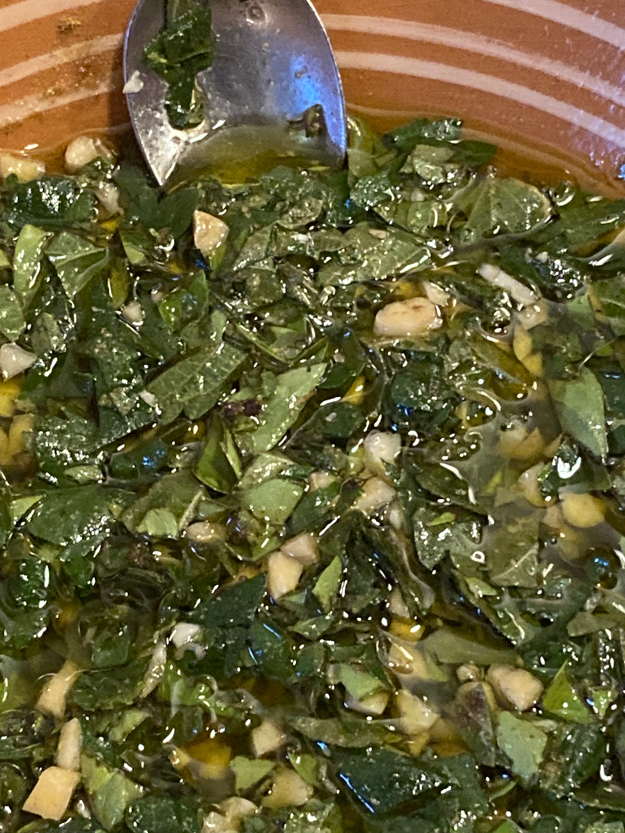
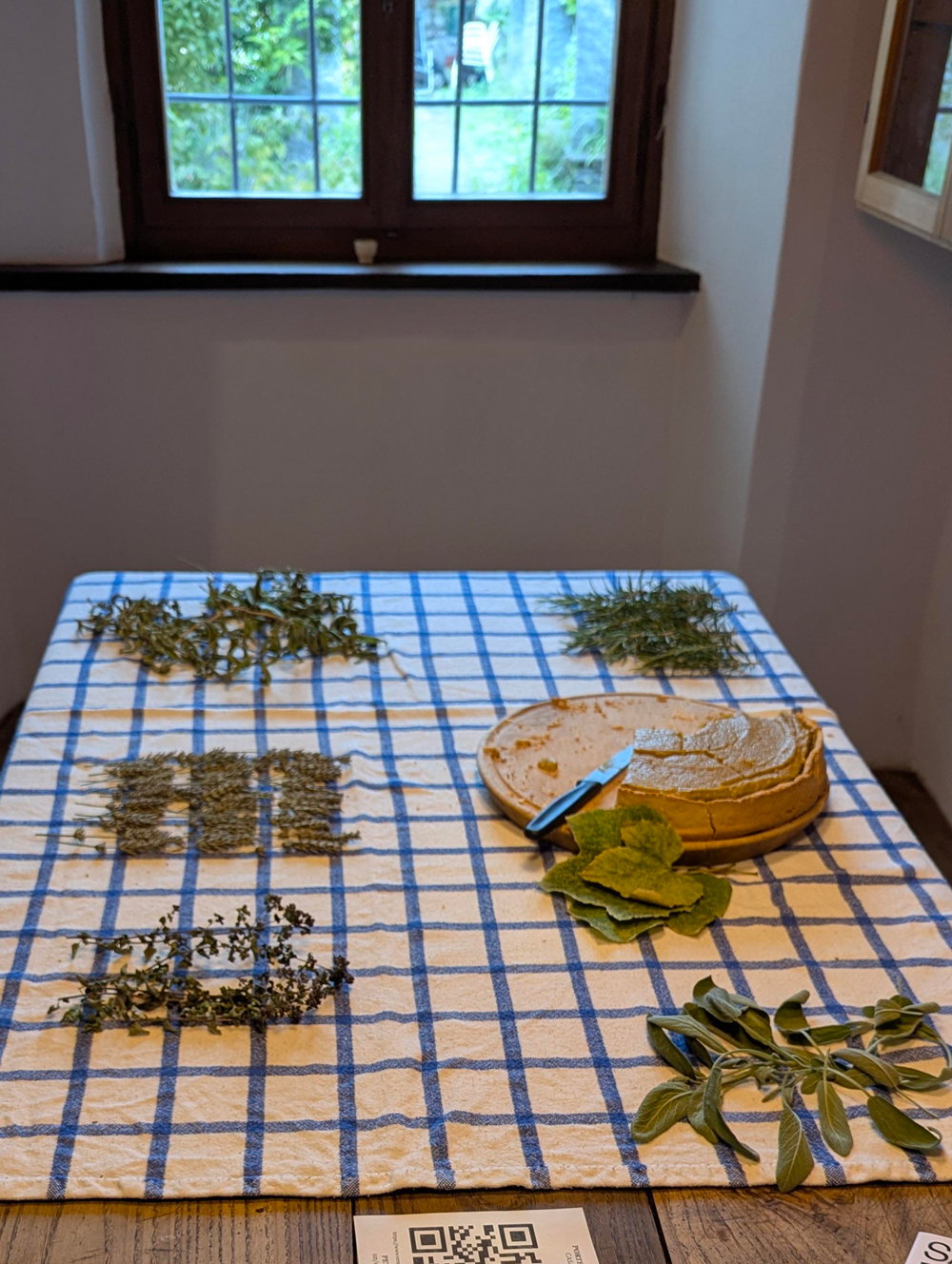
image © vera mühlebach, cassiane c. pfund, 2025
PETIT PESTO
un/eins/uno/one
CONSERVES
zwei/due/two/deux
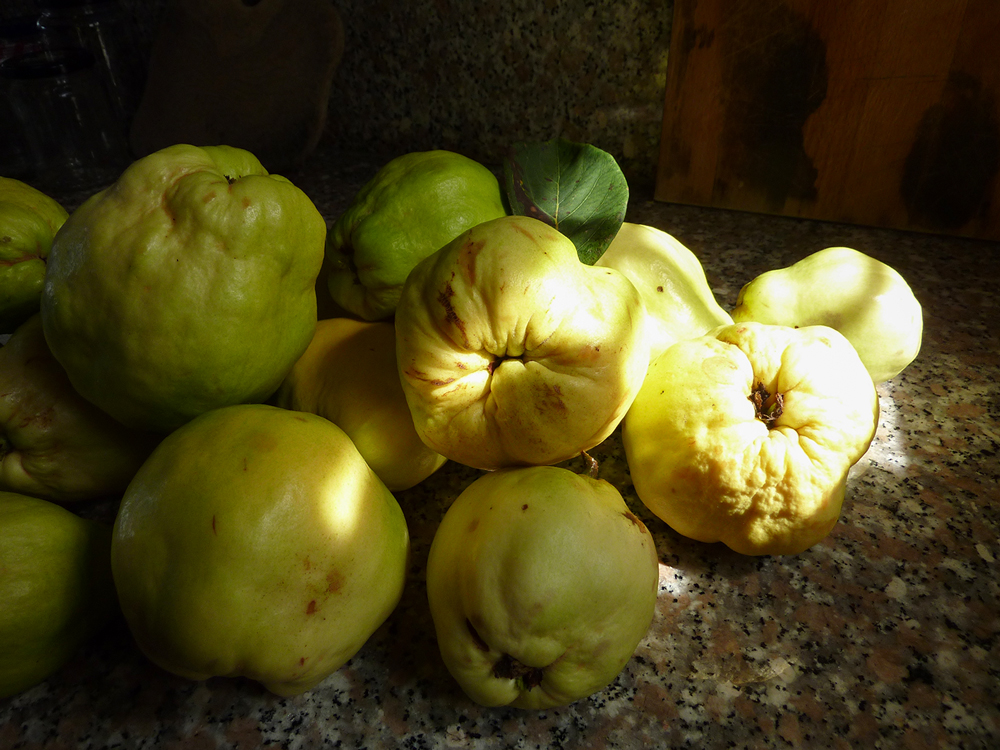
Quelle belle invitation nous est offerte par ce jardin de venir cueillir des coings, des raisins blancs et bleus, de chercher des herbes, des feuilles de figue et de framboisiers, des orties! De les rassembler, les transformer, les consommer, les conserver.
Avec les coings venaient des histoires.
– J’ai rencontré les coings, ma nouvelle passion, à l’école primaire. christine, la maîtresse, avait dédié deux jours à la confection de gelées. c’était beaucoup de travail pour deux petits pots que j’avais pu ramener à la maison. aujourd’hui, on remarque qu’il est difficile de trouver des coings au supermarché, ce sont des fruits qui coûtent cher. quel plaisir quand j’ai aperçu le cognassier par la fenêtre de la cuisine, celle au-dessus de l’évier.
On a décidé de préparer une confiture de coings à la verveine.
– Mes parents avaient un cognassier dans le jardin. Une fois par année, de grandes corbeilles étaient remplies de coings et sentaient fort dans la buanderie pendant des jours – jusqu’à ce que cécile dédie presque deux jours à la production de la gelée de coing. Laissant de côté le ‹chrüschi› – la chair du fruit – que, même si ou parce qu’elles le considérait moins bon, cécile et marlis le mangeaient elles-mêmes.
Entre temps, l’arbre, déjà vieux à l’époque, est mort. On parlait de l’âge des arbres et du fait que des fois on oublie ça. Une gelée de coings a été produite.
Claude a trouvé plein de vers dans les coings qu’elle découpait et demandait si quelqu’un d’autre pouvais sortir les déchets organiques – parce que les vers, leur mouvement, leur quantité, la dégoutaient trop. Elle a fait une confiture de coing caramélisée et une autre non-caramélisée. Elle a mis les pots à leur endroit et a proposé aux autres d’en prendre avec elleux quand iels partiraient du lieu.
Partager les conserves.
Pourquoi conserver?
Le passage du temps provoque des sentiments quelque peu contradictoires en moi: passant
du simple constat que ‹le fleuve n’est jamais deux fois le même›, à l’observation de pratiques de retardement de pourriture pour se nourrir au moment du repos de la nature, au sentiment nostalgique jusqu’aux sentiments transcendantaux – religieux ou artistiques – de vanité.
La temporalité des pratiques artistiques collectives se situe selon mon expérience également dans une tension intéressante. Vu que ces pratiques expérimentent et travaillent souvent avec des relations entre humaines et des structures d’organisation que personnellement je n’ai pas appris ni intégré en grandissant, elles nécessitent un investissement de temps et d’énergie pour établir et apprendre ces nouveaux rapports entre humains, et au monde.
D’un point de vue pratique il faut avoir ce temps à disposition.
D’un point de vue pratique, peu de pratiques artistiques collectives ont une longue durée de vie, encore moins persistent elles dans le temps. Il a été enrichissant pour moi d’apprendre de ces formes d’organisation présentes et passées.
Est né le souhait d’une pratique de transmission et de partage. Passant par le rassemblement de pratiques, de relations, d’aspirations et de structures qui ont des traits similaires. Rassembler des pratiques collectives parce qu’on imagine que leur association, leur alliance, leur masse peut leur donner plus de poids.
DES PÊCHES AUX AMANDES
tre/three/trois/drei
KATZENKOPFPFLASTER
six/sei/six/sechs
She said: the stones for this style of pavement have been collected in the valle maggia region. Even though one can buy them nowadays in a stone quarry, those used in the backyard are probably very old. Do you want to hold it in your hand ? Its comfortable, beautifully round, not too heavy – reassuring. A friend of mine who is a gardener told me that this style of pavement is called ‹katzenkopfpflaster›.
Cat head plaster.
Pavé en tête de chat.
She said: carefully aligning the stones, making sure their upper edge is at the same level, many stones together allow the realization of a stable ground. You can see it on this photo, how they did it. Adjusting stone after stone with their hands. All by themselves. What is interesting is how the ground feels when walking bare feet: it hurts a little but not quite, you need to find where to put your weight, be aware of how you are walking… when you can.
In fact, I like to see it as both an invitation and a reminder to address the crucial question of access(ibility) when it comes to collective (art) practices. Perhaps, aiming towards holding a shared sense of proximity requires listening and honoring each other’s body and the stories it carries. Thinking that we are all equal in such space without addressing power dynamics as well as privileges produces oppression by recreating multiple blind spots. Rather, my intuition is that a central focus could be directed towards finding equity through needs and lived experiences. And as such process defies production logics, as well as funding institution guidelines and deadlines, it is more than necessary to acknowledge that it takes time. Especially if we want to see it evolve through time with the desire to instaure a sustainable practice.
Then, questions arise: How do I imagine ‹ground-work› and the wish to nourrish a stable ground from where to start? And what does stable mean?
If I were an octopus, the attempt to connect with each of my eight tentacles to another ground would be more reassuring than if I tried to do the same with my only two human legs. This association immediately produces an undecided – torn apart – ever changing image in front of my inner eye. Admittedly, the comparison flaws: octopuses don’t need stable ground to ‹stand on›, to feel comfy and vivid. They need water around them.
Here, we are tra lago e monti, entre lacs et montagnes, between lake and mountains. When looking through the window, just like casa sasso, there is a constant feeling of being supported by the landscape accompanied by a deep sense of trust which is fed by the simple fact of standing on the slope of a mountain.
Almost each morning, I go down to the lake for a swim. I never know in advance what the current nor the temperature will be like. I close my eyes, confide my body, and try. At the moment, floating procures a more reassuring feeling than standing, ‹going to› or climbing on mountains. This malleable, undefined form of herstory that runs through time, intersects and translates outside of gravitiy would be my ground. One that feels warmer, closer and more sensible than a stone floor, made up of very old stones.
At the same time, following the metaphor of the cat head pavement, this would fit into one stone. The stone I bring to the floor would thus be of the kind ‹mollusc-stone›. Because yes, a common ground, ground-work, or a base to collectively start from is needed for any form of collective organisation –actually for any form of social organisation.
In that sense, the old photo that was shared is beautiful and telling, if we want to start a growing inventory of collective art practices. The story of the cat head plaster of our backyard of the residency sasso in vairano, gambarogno shapes an imagination about the way we assemble, bring together and transmitt amongst and for us.
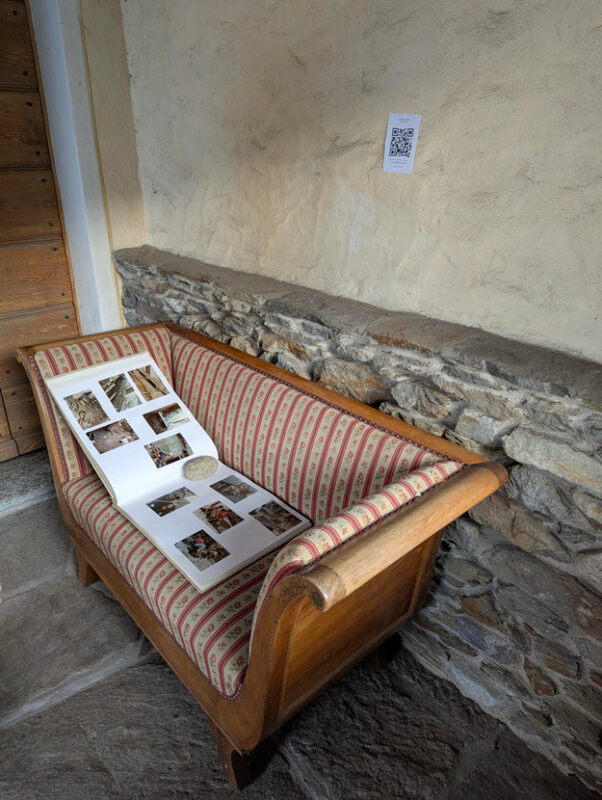
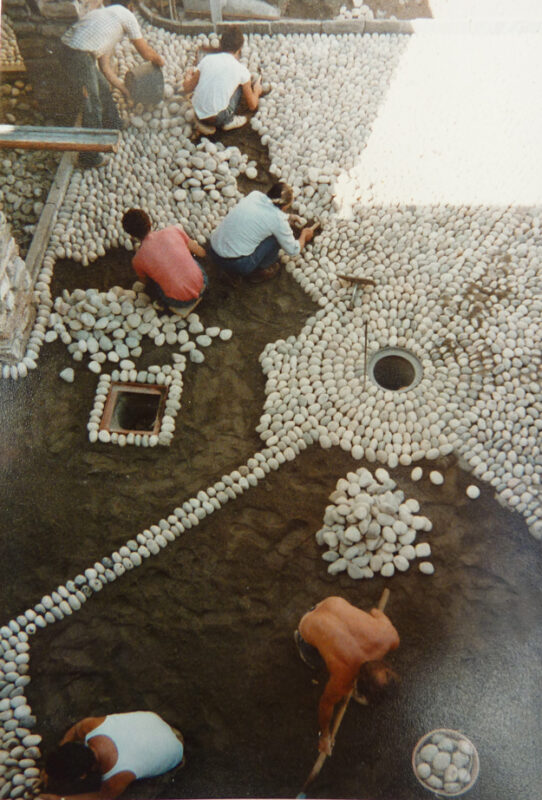
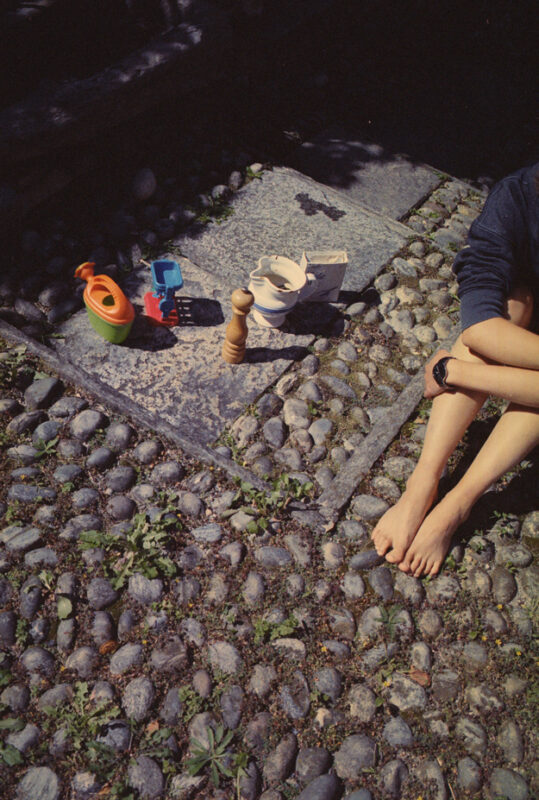
image © cassiane c. pfund, vera mühlebach, claude bühler, 2025
GRAZIE / MERCI / DANKE / THANK YOU
mirjam, claude, gin, francesca, vera, cassiane
rocco, frank
elys for the sound recording
the team of CASA SASSO
the funders who supported us